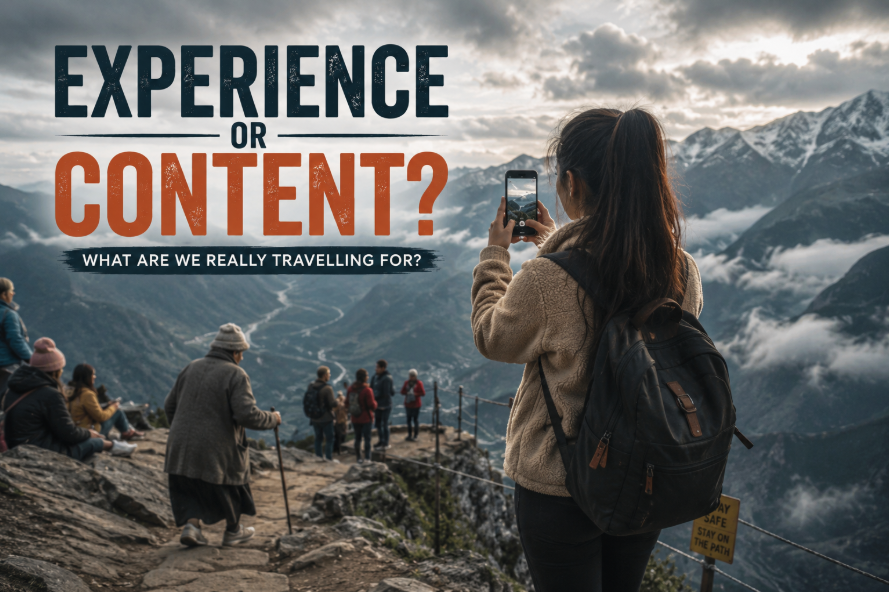
Has travelling lost its meaning in the social media crazy world?


There was a time when traveling meant the discovery of places, people, and even yourself. You packed a camera for memories, not validation. These days, though, in the hyper-connected world where everything gets filtered, captioned, and uploaded in real time, many are left to ask themselves this: Has traveling lost its meaning?
Places like Instagram, TikTok, and YouTube have transformed travel into performance. It is no longer about where one goes; it's about how aesthetically a person goes there. The result is a generation of travelers who chase algorithms more than experiences.
The rise of the "Social Traveler"

Scroll through any travel hashtag, and there it is: the same beaches, the same cafes, the identical "wanderlust" poses. What once symbolized freedom and curiosity has turned into a carefully curated highlight reel. Over 70% of Gen Z and millennial travelers claim that they decide on destinations according to social media trends, one to a survey conducted by Statista discloses for 2024. The Maldives, Bali, and Cappadocia are not just travel hotspots but rather "content destinations."
The irony, of course, is that the more we post about traveling, the less authentic it all feels. Every sunset becomes a prop, every meal an aesthetic, and every adventure a backdrop for engagement.
Traveling for validation rather than exploration

In this race for likes, the spirit of traveling has shifted from exploration to exhibition. Instead of experiencing the famous landmarks, people visit them in order to photograph them, waiting sometimes even in long queues for those shots that have gone viral. But there's also a deeper psychological layer: Social media runs on comparison. The moment travel becomes currency for that self-validation, authenticity suffers. The joy of getting lost in a new city, the meeting of strangers, the slow exploration-it gets replaced by anxiety over lighting, angles, and captions.
According to The Guardian,
"Travel is no longer about where you go, but how the world sees you going there."
Impact on the local culture and environment

It is this performative mode of travel that does not affect the travelers alone but extends to the places they go. It has promoted "Instagram tourism," with once-peaceful spots now becoming overcrowded. Places like Santorini and Kyoto struggle to balance heritage preservation against a new influx of selfie-driven visitors.
Meanwhile, locals often feel reduced to part of the scenery. In place of interactions, there are transactions: quick photos, quick tips, quick exits. What started as a cultural exchange risks becoming cultural exploitation. Environmental concerns also arise in this respect, where short travels-and especially influencer-driven ones-only add to carbon emissions and take modern tourism even further away from its roots of appreciation and respect.
Rediscovering the real meaning of traveling
So, is the meaning of travel really being lost? Probably not entirely-it's just changing, and not necessarily for the better. Amidst all that din, many are taking back travel for themselves. "Slow travel" movements, digital detox retreats, and sustainable tourism are now trending for people who have grown tired of shallow escapes.
We need to step back from the feed and step into the moment if we are going to travel meaningfully again. The question then becomes: If you couldn't post it, would you still go? If the answer is yes, that's real travel.
Continue navigating The ScreenLight for more such recommendations.