Has Travel Become More About Content Than Experiences?

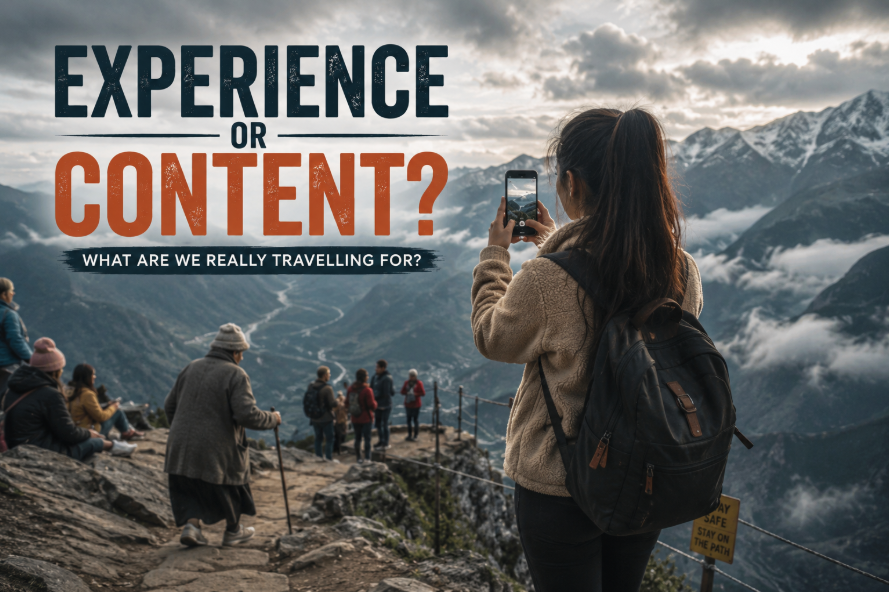
For a generation that grew up watching their parents spend most of their lives working, saving, and postponing things for later, the idea of “I'll travel when I retire” doesn't sound particularly attractive.
Why wait?
Life is short. Work will still be there when you come back. So will the emails.
That mindset is one reason travel has become more than a holiday for many young people. It is a break from routine, a chance to see something unfamiliar, meet new people, try different food, or simply spend a few days somewhere that doesn't look like the view from the office window.
But there is a strange part of modern travel.
We leave our everyday routine behind, only to carry a smartphone that records almost everything we do. So, has travel become more about creating content than experiencing the place itself? We’ve explored a similar question before: has travelling lost its meaning in the social media-crazy world?
We don't just discover places anymore. We discover them online.
Before social media, you might hear about a beautiful destination from a friend, a magazine, or a travel show. Now, you can see the hotel, the mountain viewpoint, the café, and even the exact angle for the photograph before booking the ticket.
That isn't necessarily a bad thing.
Delta's 2026 global Connection Index found that 73% of travellers had taken a trip specifically to see something they first discovered online. At the same time, 79% said that experiencing something in person feels more meaningful when so much content can be generated or altered digitally.
That contradiction is worth noticing. Social media can make us want to leave the screen and experience something for real. The screen can actually become the reason we travel.
The rise of the “hidden gem” traveller
There is another change happening. A lot of young travellers aren't interested in visiting only the obvious tourist attractions. Travel itself is changing too, from set-jetting and coolcationing to noctourism and wellness trips.
They want quiet beaches, lesser-known villages, small cafés, mountain trails, and places that don't already look like everyone's holiday album. The phrase “hidden gem” has become almost a travel category of its own. And social media is very good at finding these places. A creator discovers a quiet viewpoint and posts it. Thousands of people saved the video. A few weeks later, the “hidden” location may be sitting on hundreds of travel itineraries.
Research backs up the influence of this content. A 2025 study examining travel influencers found that influencer content can affect how people process information and make destination choices across different stages of the travel journey. Another study focused specifically on Indian Gen Z found that the perceived authenticity of influencer content can influence attitudes and intentions around sustainable travel.
So yes, people are being influenced by what they see online. But that doesn't mean they're travelling only for Instagram.
A photo can be a memory, not a performance
This is where the conversation often becomes unfair. Someone taking photographs during a trip isn't automatically showing off. Maybe they want to remember the place. Maybe they want a video of their friends laughing five years from now. Maybe they know that life changes quickly and want something tangible from a particular moment. There is a difference between documenting a memory and performing a memory for an audience.
But what does travel look like from the creator's side? This video explores the reality of creating travel content, including the part that viewers don't always see. The first one can make an experience more meaningful. The second can sometimes take us away from it.
Imagine standing in front of an incredible sunset. You could take a few pictures and then put the phone away. Or you could spend the next 20 minutes changing angles, checking the lighting, recording another take, choosing music, and wondering whether the final Reel will perform. The sunset is the same. But your relationship with it isn't.
When the camera becomes the reason for going
The real problem begins when the content becomes more important than the trip. A destination gets popular because it looks beautiful online, so people go there mainly because they want the same photograph. A restaurant becomes a must-visit because everyone has posted about the same table. A hotel room becomes desirable because of one particular mirror selfie.
At that point, travel can become less about “What will I experience here?” and more about “What will I post from here?” And there is a quiet pressure behind that question. If everyone else's holiday looks incredible online, your own trip can start feeling like it needs to look incredible too. That can turn travel into another form of performance.
Maybe young people are actually travelling more for life, not likes
This is the part that gets missed. Young travellers aren't necessarily choosing travel over real life. For many, travel is part of real life. They've watched parents spend decades working around responsibilities. They've seen how health, family commitments, and age can eventually make spontaneous travel harder.
So, they don't necessarily want to wait for some perfect future version of life.
They want to see the mountains now.
Swim in that sea now.
Eat that food now.
Take that road trip with friends now.
And if they also make a Reel from it, that doesn't automatically make the experience fake. Research from Delta's 2026 report supports this broader desire for real-world connection. 84% of surveyed global travellers said they felt a strong desire to travel and connect with new places and people, with the feeling particularly strong among Gen Z and Millennials. The content may simply be the record of something they genuinely wanted to experience.
So, has travel become more about content than experiences?
Sometimes. But not as much as the question might suggest. Social media has changed how we discover places, choose destinations, and remember our trips. It has also created a temptation to turn every experience into something shareable.
But taking a picture doesn't mean you weren't present.
Posting a video doesn't mean the trip was for attention.
The better question is what came first. Did you travel to experience the world and create a memory from it? Or did you choose the destination because you already knew it would look good online?
Maybe the real luxury in travel today isn't visiting the most expensive place or finding the most Instagrammable view. It's being somewhere beautiful and, for a moment, not feeling the need to prove that you were there.
Keep reading The ScreenLight for more travel stories.


